Gary Davies
A reflection
Back in early 2010 I was lined up to start my first role out of university, when I got a phone call to suggest I might be placed on a different path. To gauge interest I was sent along to Queen’s University Belfast to chat with a kdb+ SME, a meeting which set me on the journey with kdb+. The plan was simple: build a pipeline of STEM graduates alongside experienced engineers.
This is not a unique recipe, but a tried and tested approach that many companies and consultancies have followed for years – in fact it was the bread and butter in the formation of AquaQ Analytics (Data Intellect today). In order to build great engineering teams and companies you must seed graduates to build a pipeline, to replace the experienced engineers who you may lose to new projects, new roles, new clients or new jobs.
When I go on-site to visit clients, often I am visiting kdb+ colleagues I’ve worked with previously, but now they are positioned across a variety of clients – this shows me the niche community that I am a part of, but also the dynamic nature of the roles and people within it.
However, as we head into the last quarter of 2026, I am seeing two things that need to be addressed around this most critical of pipelines.
- The experience gap
- The stunted pipeline
An observation: the experience gap
Being part of the largest kdb+ consultancy, I can observe the kdb+ demand and supply across the market. What intrigues me right now, and has been growing throughout this year, is that there is a significant experience gap.
The market itself is full of demand right now, with many roles open – both to consultancies and to full-time employees. Many may think, well surely that’s a good thing, and it is, but the problem I see is best demonstrated through a high-level example.
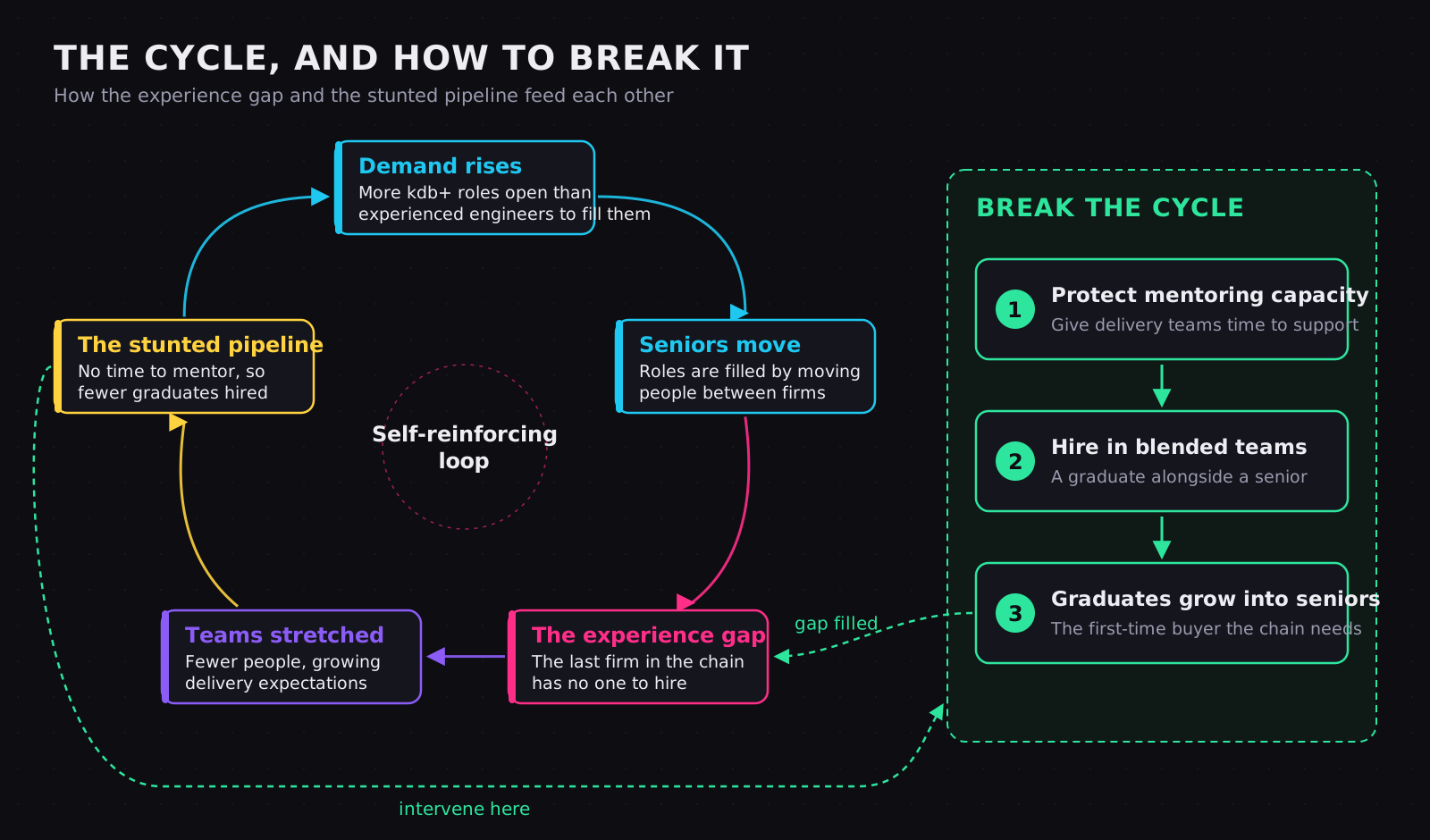
- Tier One Bank ‘A’ has a Senior role open – they fill it from Hedge Fund ‘B’
- Hedge Fund ‘B’ now has a gap so they fill it from Tier One Bank ‘C’
And this could keep going on, not dissimilar to a chain when buying a house. The problem is that in many cases there is no first-time buyer.
Tier One Bank ‘C’ in this scenario will look to fill like for like on experience, and, as we see right now, demand is much higher than the supply.
If we look at the supply side of things there are some observations I’ve made there too, and two of them contribute to the issue:
- Some of the community has moved, and is still moving back home or into fully remote roles – a problematic factor when clients need in-person presence on site
- Some have moved on to other things – as happens with careers people may pivot out of kdb+ development and it might not be as simple as just moving to another role in capital markets, it could even be to become a teacher for example.
Both of these narrow the pool of experienced engineers in the supply.
This raises a question I don’t think enough teams are asking: if your senior kdb+ engineer handed in their notice tomorrow, who picks up their work? In a market where like-for-like replacements are scarce, a role can sit open for months. In that time, the knowledge that person carried leaves with them. The best backup plan is someone already in the team, learning alongside them. That’s a role a graduate can grow into.
An observation: the stunted pipeline
If the supply of experienced engineers narrows what you end up with is people transitioning between kdb+ roles but there always being gaps somewhere unfilled.
Normally this gap would be filled, at least partially, by those coming into the domain – a sharp junior, a tech graduate – taking on their first role and coming up the curve. However in 2026 I believe those opportunities have narrowed. Don’t get me wrong, there is still graduate demand, as demonstrated by our continued hiring and graduate cohorts – the problem is it’s not big or wide enough. The number of clients taking on graduates has slimmed, and they are the ones that continue to benefit from filling their own gaps.
You might be thinking, “this must be the AI effect”. I don’t believe it is. There could be some impact, but there is still the need for experienced engineers to steer it.
So if it isn’t AI, what is it? Good question. I believe it’s a lack of time. We see across our client base, and I hear from colleagues that they are under delivery pressure, with growing expectations. Graduates come in needing a level of support and guidance, and if no one has the capacity, or indeed time to do that why would you bring them on? Or the alternative is they come on, don’t get the support and either look like they’re underperforming or they leave. This feels a bit doom and gloom but it’s worth calling out as it’s causing us all to miss a step.
As a relatively new parent I’ve heard the saying many times it takes a village to raise a child – well it takes a strong team to raise a kdb+ graduate. I look back to 2010 and I can say I had four people providing me mentorship, guidance and training to some degree directly, and many more indirectly. Without them I don’t make it to where I am today. And that was without a formal training programme. Today, the Data Intellect programme takes around 60 people (trainers, mentors and assessors) to produce one graduate cohort
The problem this creates is a stunted pipeline that needs more graduates, and soon. It also does something else – those teams who are working to deliver, and don’t have enough people, come under pressure and deadlines get missed, and the cycle continues – there is no room to break it.
The Direction
A stunted pipeline will just cause the experience gap to grow and the problems to worsen, so what do I propose we do?
I feel it is simple, more kdb+ graduates into the market, more into jobs, more into clients – and giving them the support they need to make them successful. No kdb+ engineer in the market can say they came into it experienced, you couldn’t learn it at university, you learned it on the job, or via a consultancy programme and you learned it from the people who supported and brought you on the journey.
There is one more point worth making. Earlier I mentioned experienced people moving home or into remote roles, just as clients are asking for more people on site. Graduates are often the ones who want to travel and see the world. Many of the people moving home were those same travelling graduates ten years ago.
Some people may be thinking, oh well this is clearly a sales pitch for graduates, and of course to an extent it is. More graduates bring Data Intellect more business, but personally I have genuine concern that the market is not creating the supply to meet today’s demand so how can we meet the future?
I’ll be upfront. Right now, at Data Intellect, we have more requests for experienced kdb+ engineers than we can meet. Most of the asks we get are for experience, and our clients tell us they can’t find it themselves either. If the largest kdb+ consultancy can’t meet that demand, and the firms hiring directly can’t either, the answer isn’t to keep competing for the same small pool.
So I’d like to propose a joint effort. We bring the graduates, the training and the senior cover. Our clients bring the environment, the real problems and a commitment to take graduates on. Together, we grow the engineers the market needs, rather than moving the same ones around.
Our graduate gateway training programme has continually produced fantastic talent which is now distributed across the kdb+ community, be it those who are still consultants at Data Intellect or who have roles directly with the banks and hedge funds. In 2026 the programme has been recognised with a Princess Royal Training Award honouring organisations that demonstrate outstanding commitment to learning and development, and highlight the tangible impact of exceptional training on both organisations and individuals.
What’s the takeaway? If you’re seeing this in your own teams, or those you manage, here are some practical steps:
- Partner with us on a joint graduate initiative.
- Know who your backup is for each senior, and start building that cover now.
- Hire in blended teams, with time protected for mentoring.
- Pair an on-site graduate with an experienced remote engineer, so the graduate gets trading floor experience.
Or, at the very least, set us a challenge to prove that graduates can deliver.
Build your kdb+ pipeline. Let's chat.
Share this: