Read time:
3 minutes
Samantha Devlin
What’s the problem?
All surveillance analysts know this moment well: you log in, open the dashboard, and immediately see alert volumes are far higher than usual. What should have been a manageable queue has become a backlog, and the day is quickly consumed by reviewing and resolving/escalating cases.
Most surveillance platforms support analysts well in their investigations, but the real work often begins when those standard capabilities fall short – the data may sit outside the platform, the behaviour may need wider market context, or the analyst may need to combine multiple sources to understand what really happened.
That fragmented process is where investigations slow down.
Our solution
Your workflow starts as above, but now you are supported by an AI Assistant.
From the outset, the Assistant provides additional context around each alert, so rather than starting from scratch, you are presented with a clearer picture of what is happening and why. It highlights relevant trading behaviour, surfaces related instruments or activity, and begins to point out patterns that may not be obvious at first glance. You can do peer comparison for individual traders, surface price movements for related instruments around the time of the alert, and flag market volatility driven by global news events.
The focus shifts away from simply understanding the alert, and towards interpreting the behaviour behind it.
One of the most noticeable changes is how seamlessly the Assistant bridges gaps in data. Surveillance investigations rarely live within a single system, and analysts often spend a significant portion of their time navigating between tools, databases, and internal resources. The Assistant removes that friction. It can query connected backend databases, integrate with existing data infrastructure, and bring in additional sources where needed. At the same time, it can reference internal documentation, such as company policies or platform documentation, and align findings with regulatory definitions drawn from relevant handbooks.
What would previously have required multiple steps, systems, and manual effort becomes part of a single, continuous workflow.
Gaining new insights
It’s very difficult for traditional surveillance systems to be able to operate across various forms of data without having to normalize them in some strict and predefined ways. This Assistant offers capabilities to surface critical insights that were not possible before, such as:
-
Merging alerts with unstructured ecomms data (including voice) and external streaming news feeds (useful for building cases)
-
Peer comparisons for trader profiling (surfacing patterns)
-
Reasoning to support calibration of thresholds and benchmarks (aiding quarterly/annual calibration exercises)
-
Preemptive explanations of sudden influxes of alerts (market volatility rationalized by external context, or abnormalities in internal data loads)
Beyond simply aggregating information, the real value comes from how the Assistant helps generate insights like these. Patterns across alerts become easier to identify, anomalies are surfaced quicker, and the analyst is accelerated through the plausible lines of enquiry. In many ways, it acts as a second set of eyes, offering consistency and speed without replacing the analyst’s judgement.
How does it work?
The interaction itself is deliberately simple. Investigations can be initiated with a single click or prompt, and the Assistant maintains context throughout the conversation. Crucially, every response is designed with explainability in mind, combining a clear summary of findings with supporting evidence, underlying queries, and suggestions for what to explore next.
Behind the scenes, an orchestration layer manages the flow of the investigation between LLMs, databases, and external knowledge sources. It keeps track of context – the investigative thread, prior queries, and intermediate findings. It also contains the instructions that enable your organisation to apply behavioural instructions and constraints that direct the Assistant in its activity, keeping you in control and in line with governance requirements.
Meanwhile, the MCP layer enables the Assistant to leverage both internal and external sources ensuring the Assistant can enrich alert contexts with market data, news feeds, regulatory handbooks, and pattern recognition.
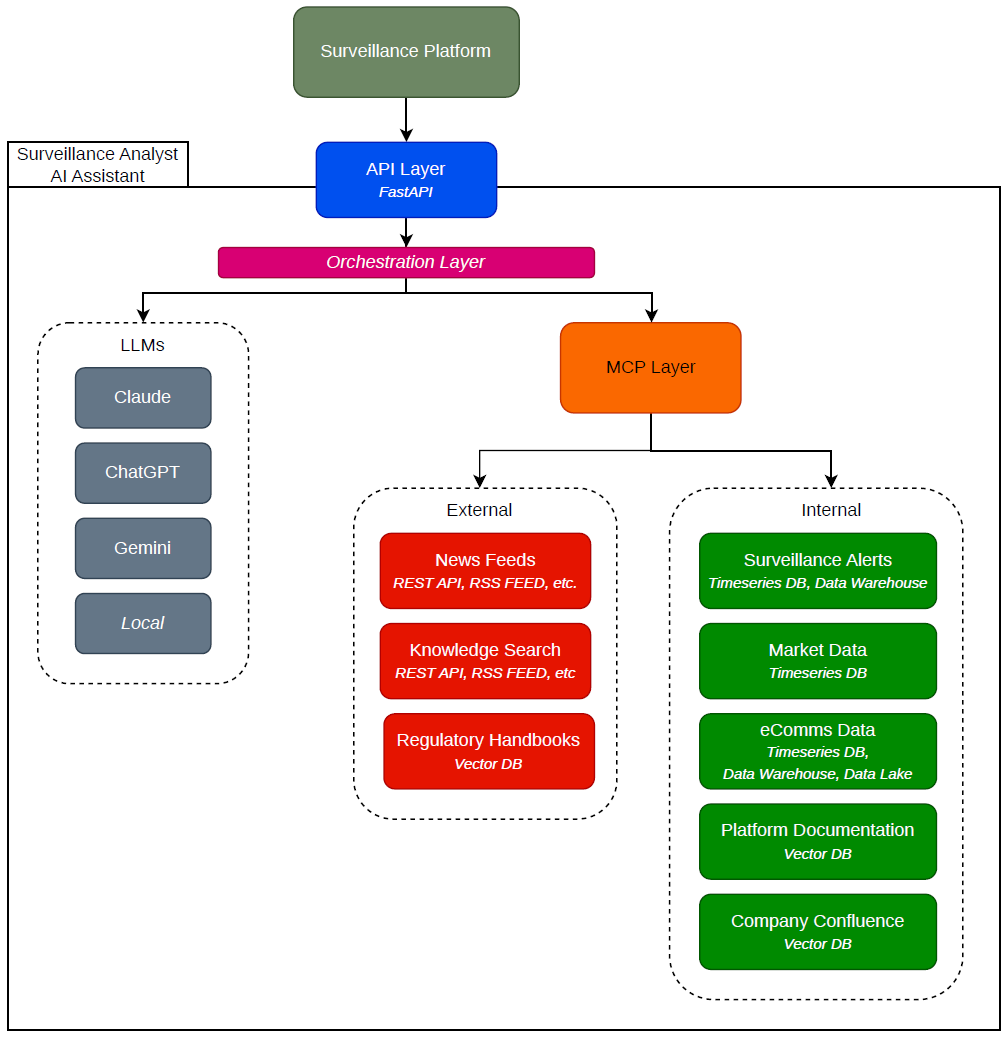
Importantly, this approach does not require organisations to overhaul their existing infrastructure. The Assistant is designed to be flexible and adaptable, integrating with a wide range of databases, warehouses and lakes, and sitting alongside existing surveillance platforms. It is fully configurable to compliment the environment it operates within.
Why this matters
What this ultimately changes is not the responsibility of the surveillance analyst, but the way they spend their time. The core of the role – applying judgement, making decisions, and ensuring regulatory compliance – remains unchanged. What improves is everything around it. Investigations result in faster closure of false positives, more consistent alert escalation, quicker case building, and seamless cross-database querying.
As data volumes continue to increase and market behaviour becomes more intricate, the ability to augment human expertise with intelligent systems is becoming essential. The role of the analyst is evolving, and the technology supporting that role needs to evolve alongside it.
Want to see a demo?
Share this: